Insight · Breach Analysis
Seven Million Driver Records, Halted Taxis and Agentic Ransomware: What This Week Tells Us About Data Exposure
A single week in July 2026 brought a seven million record insurance breach in the United States, a malware shutdown at Japan's largest taxi operator, mobile network spying against US military personnel, and the first documented agentic ransomware operation. The common thread is data that lived where attackers could reach it.

Mark FermorCTO, CMO and Founder, Firevault
Published 20 July 2026 · 4 min read
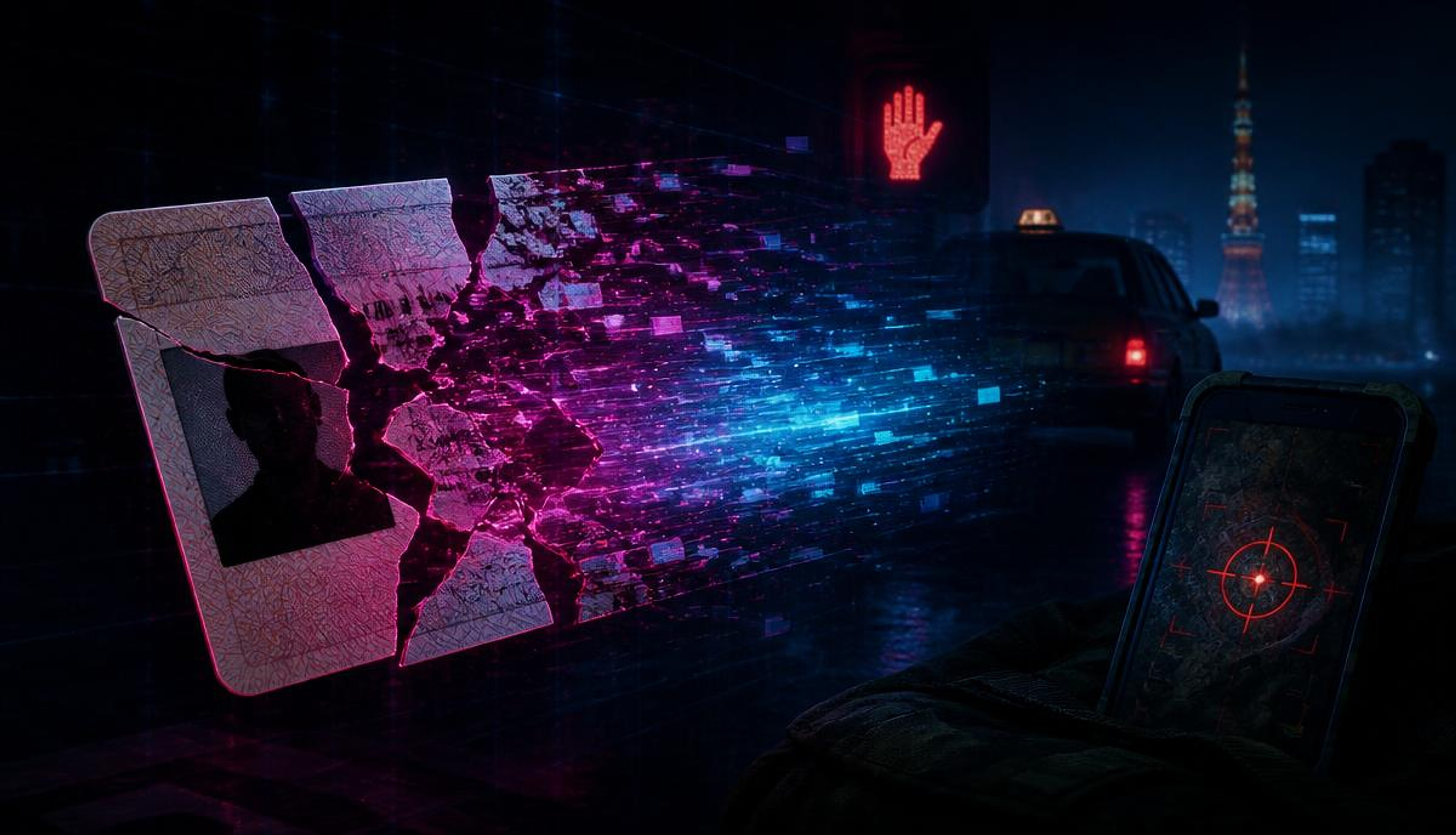
Shattered driver licence, halted Tokyo taxi and targeted military smartphone rendered in magenta and cyan data streams, illustrating the week in cybersecurity incidents
Author: Mark Fermor, Director and Co-Founder, Firevault. Analysis of the week ending 17 July 2026, drawing on reporting by PCMag, the Financial Times, Security Affairs, Business Insider and Sysdig.
AssuranceAmerica: close to seven million drivers exposed
The headline breach of the week hit AssuranceAmerica, a motor insurance provider operating across fourteen states in the United States. Attackers walked away with personal data on close to seven million drivers, including contact details, driving licence information, vehicle records and claims history. The scale only became public because Maine's state notification law forced disclosure, a reminder that regulatory transparency is often the only reason customers ever learn what has happened to their information.
For anyone whose data now sits on a criminal forum, the practical exposure is long lived. Licence numbers, vehicle identifiers and claims narratives do not rotate the way a compromised password does. They feed identity fraud, targeted phishing and insurance manipulation for years.
Nihon Kotsu: malware halts Japan's largest taxi fleet
In Tokyo, Japan's largest taxi operator Nihon Kotsu was forced to take booking and dispatch systems offline after a malware infection. Passengers were left without rides while the company worked to contain the incident and understand its origin. Security Affairs carried the full account, including the company's public apology.
The lesson is one Firevault has made before. When operational systems live on the same network as the data attackers want, a security incident becomes a service outage. Customers feel it long before the incident response report is written.
US military phones targeted through SS7
The Financial Times reported that attackers in the Middle East have been probing mobile and advertising technology networks to locate devices belonging to US military personnel stationed in the region. The method involves the long known SS7 signalling flaw, used as a ping to flush out handset locations. Senator Ron Wyden described it as potentially the first use of commercially available data to spy on American personnel during an active conflict.
The uncomfortable truth is that the surveillance economy sells the same signals to everyone. Once mobile location data and advertising identifiers are collected at scale, adversaries can buy or steal what allies collected for marketing.
Jade Puffer: the first agentic ransomware
Researchers at Sysdig, reported by Business Insider, revealed Jade Puffer, believed to be the first documented example of agentic ransomware. A large language model is given the objective, chooses the targets, selects the tooling, executes the intrusion, encrypts what it finds and reports back on progress. The techniques are not new. The automation is.
What used to require a team of operators can now be handed to a model overnight. That changes the economics of ransomware and shortens the time defenders have between initial access and encryption. It also removes the human bottleneck that historically limited how many organisations could be attacked in parallel.
What connects these four stories
Each incident involves data or systems that were reachable from the open internet at the moment attackers chose to act. Insurance records held in a live application. Dispatch systems running on a connected network. Mobile identifiers moving through commercial signalling. Corporate estates waiting for an autonomous agent to knock on the door.
Perimeter controls, detection tooling and incident response all matter. None of them prevent the underlying condition, which is that sensitive data sits online by default and depends on continuous defence to stay private.
The Firevault view
Offline Secure Storage takes the opposite starting position. A vault is physically disconnected outside authorised access periods. There is no session for a remote attacker to hijack, no service to enumerate and no automated agent that can reach the drive when it is powered down. Access is one to one, per user, within defined windows, with sessions that end automatically after 120 minutes.
Agentic ransomware only accelerates a trend we have described for two years. The organisations that fare best are the ones that treat their most sensitive records, keys, evidence, matter files and successor data as offline by default and reconnect them only when a person needs them. Everything else is a race between attacker automation and defender attention.
Practical next steps
For individuals affected by the AssuranceAmerica disclosure, monitor credit files, enable multi factor authentication on financial accounts and be sceptical of any inbound contact referencing your policy. For operators of critical services, assume that connected dispatch, booking and identity systems will be targeted and rehearse the manual fallback. For anyone holding data that would cause harm if exposed, ask a simple question. Does this need to be online right now, or can it live offline until someone actually needs it?
Sources: PCMag UK, Financial Times, Security Affairs, Business Insider, Sysdig research disclosure.
Questions
Close to seven million driver records were taken, including contact details, driving licence information, vehicle data and claims history across the fourteen US states where AssuranceAmerica operates.
Agentic ransomware uses a large language model to plan and execute an attack end to end, from target selection through intrusion, encryption and reporting. Sysdig's Jade Puffer research is believed to be the first documented example.
Every incident this week involved data or systems that were online at the moment of attack. Offline Secure Storage keeps sensitive records physically disconnected outside authorised access windows, which removes the surface an automated attacker or remote intruder needs to reach them.
About the author
Mark FermorCTO, CMO and Founder of Firevault. Mark writes on physical control, offline storage and the incidents that show why both matter.

Why #OSS
Keep a clean copy out of reach.
Offline Secure Storage® keeps one copy physically disconnected at the hardware level between sessions.

Control
Govern the paths attackers depend on.
Physical, out-of-band control of selected network paths, composed into ten Blueprints.

Ready to start?
Create your Vault online.
Business Vaults from £360 a month inc VAT, on a 36-month commitment.