
News · Breach Analysis
Coca-Cola Halts fairlife US Production After Ransomware Hits Dairy Systems
A ransomware event at fairlife, Coca-Cola's billion-dollar dairy subsidiary, forced the company to suspend all United States production on 16 July 2026. The incident shows how a single IT breach can stop physical manufacturing lines and disrupt consumer supply chains.

Mark FermorCTO, CMO and Founder, Firevault
Published 20 July 2026 · 8 min read
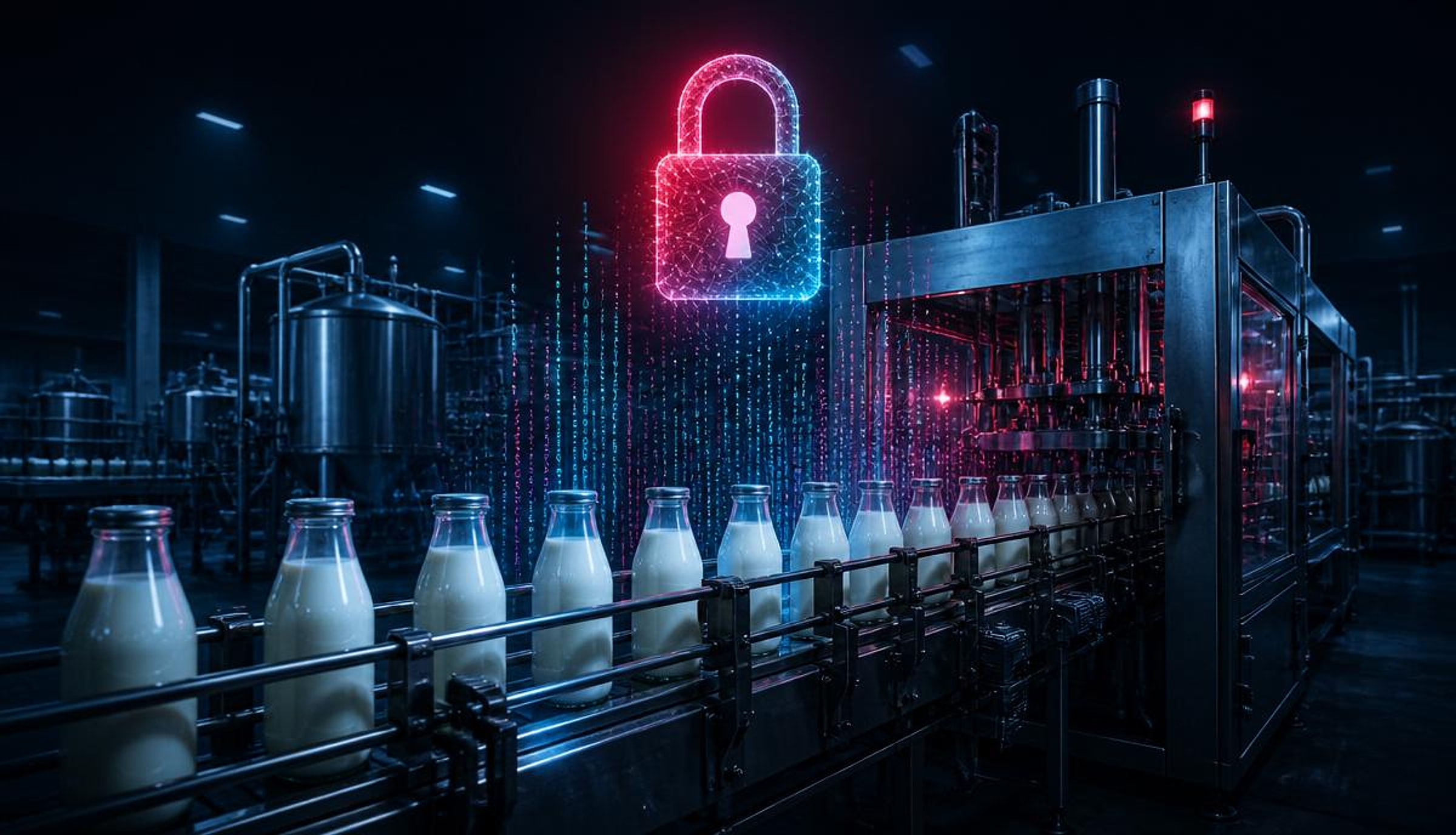
Dairy bottling production line halted by a glowing ransomware padlock, illustrating the fairlife cyber incident and the risk of operational disruption
On 16 July 2026, The Coca-Cola Company disclosed that fairlife, LLC — its wholly owned dairy subsidiary and a billion-dollar retail brand — had suffered a ransomware event that forced the immediate suspension of all United States production. The disclosure, made through a press statement and a Form 8-K filing with the U.S. Securities and Exchange Commission, is one of the most visible examples in 2026 of how an IT security incident can halt physical operations in a consumer goods business.
According to the SEC filing, fairlife detected unauthorised access by a third party to a portion of its systems, including its production-related systems. As a direct result, Coca-Cola chose to stop fairlife US production while it investigates, restores systems, and works with external cybersecurity advisers and law enforcement. The company has stated that product quality and safety have not been affected, and that fairlife production in Canada is continuing normally.
What fairlife is and why the disruption matters
fairlife is not a niche brand. Coca-Cola acquired the remaining stake in fairlife LLC from Select Milk Producers in January 2020, making it a wholly owned subsidiary. By 2022, fairlife had become Coca-Cola's newest billion-dollar retail brand, built on ultra-filtered milk, Core Power high-protein shakes, and nutrition-focused dairy lines. The brand is sold in major grocery, convenience, and club retailers across the United States, giving it a large footprint in consumer refrigerators and food-service supply chains.
When a brand of this size stops producing in the United States, the impact is not limited to the plant floor. Retailers, distributors, and food-service customers must manage shortages, substitute products, and communicate with consumers who expect consistent availability. The financial and reputational exposure is therefore much larger than the direct cost of the incident response itself.
What happened on 16 July 2026
Coca-Cola's official statement and SEC filing confirm that fairlife identified unauthorised access to part of its environment, including production-related systems, in connection with a ransomware event. The company activated its incident response and business continuity protocols, engaged external cybersecurity experts, and notified law enforcement. The full scope, nature, and impact of the incident remain under investigation.
Importantly, Coca-Cola has not publicly confirmed the ransomware group involved, whether data was exfiltrated, whether a ransom was demanded, or when United States production will resume. The company has also not stated whether the breach originated through email, remote access, a supplier, or an unpatched edge device. Those details are likely to emerge in the coming days and weeks, but the operational decision to halt production was made immediately and decisively.
Why production had to stop
The fairlife incident highlights the convergence of information technology and operational technology in modern manufacturing. Dairy plants, like many food and beverage facilities, rely on connected control systems to manage batching, pasteurisation, packaging, quality checks, and line scheduling. When a ransomware event reaches those systems, operators cannot safely assume that the equipment is producing to specification or that batch records are intact.
Coca-Cola's decision to suspend production rather than run on potentially compromised systems is consistent with food safety practice. In an environment where product quality is regulated and consumer trust is fragile, the risk of continuing production on a compromised network is greater than the cost of a temporary shutdown. The choice also protects the company from the more serious scenario of contaminated or mislabelled product reaching the market.
What is still unknown
- The identity of the ransomware group or affiliate behind the attack.
- Whether sensitive data, including customer, supplier, or employee information, was exfiltrated before encryption.
- Whether a ransom demand was made and whether Coca-Cola is negotiating.
- The estimated timeline for restoring United States production to full capacity.
- The exact initial access vector, such as phishing, compromised credentials, remote access tooling, or a third-party supplier.
- Whether any operational technology networks were directly encrypted, or whether production was suspended only as a precaution.
Until these details are confirmed, the incident should be treated as a live operational breach with an unknown recovery timeline.
The broader context: food and beverage as a target
Food and beverage manufacturers have become attractive ransomware targets because their IT and operational technology are tightly connected. A breach that starts in a corporate email inbox or remote-access portal can quickly move to the plant floor, where the cost of downtime is measured in lost output, missed contracts, and empty shelves rather than in recovery fees alone.
Recent years have shown this pattern repeatedly across the sector. Incidents at meat processors, beverage producers, and ingredient suppliers have demonstrated that even facilities without high-profile critical infrastructure status can cause national supply pressure when their production stops. fairlife is a prominent example, but the underlying risk applies to mid-sized dairies, bakeries, and ingredient manufacturers just as much as it does to global brands.
Safety, regulatory and consumer dimensions
Coca-Cola has been clear that product quality and safety have not been affected. In food manufacturing, maintaining that position depends on being able to verify batch records, ingredient traceability, and process controls. If those records are stored only on the production network and that network is compromised, proving product safety to regulators and customers becomes significantly harder.
In the United States, food facilities operate under the Food Safety Modernisation Act and FDA oversight. A cyber incident that affects production records can trigger not only a cybersecurity response but also a food safety investigation, including the need to demonstrate that no adulterated product left the plant. This is why separation between production data and a known-good offline copy is increasingly important in board-level risk discussions.
The business impact beyond the plant
The direct cost of the fairlife incident will include incident response, forensics, legal advice, business interruption, and potential remediation. Beyond that, Coca-Cola must manage retailer relationships, consumer confidence, and the risk that shoppers will switch to competitors if shortages persist. In a market where fairlife competes with private-label and national dairy brands, even a short outage can shift purchase habits.
For manufacturing leaders generally, the lesson is that production continuity is now a data-resilience problem. When the digital layer is locked, the physical layer stops. Recovery speed depends not only on the ability to clean and rebuild systems, but on having a trustworthy source of the data, recipes, configurations, and records that prove the plant is safe to restart.
How offline secure storage changes the calculus
Ransomware succeeds when the attacker controls the only copy of the data that matters. If production systems, backups, and recovery images all sit on the same connected estate, encryption spreads quickly and recovery becomes a negotiation.
Offline Secure Storage breaks that model by maintaining a physically separated copy of critical data — contracts, recipes, batch records, engineering drawings, configuration files, legal documents, and system images — that attackers cannot reach from the production network. It is not a replacement for detection, endpoint protection, or network segmentation, but it removes the single point of failure that ransomware exploits.
For a manufacturer like fairlife, an offline copy of production recipes, quality control parameters, and equipment configurations would provide incident responders with a known-good starting point. Instead of rebuilding from uncertain backups or negotiating with attackers, recovery teams could verify the integrity of the offline copy and use it to restart lines faster and with greater confidence that product safety has been preserved.
Practical next steps for manufacturing leaders
- Map which production systems, recipes, and batch records are stored only on the corporate or plant network.
- Identify the single points of failure where a ransomware event would stop output or prevent safety verification.
- Separate recovery data from production networks by maintaining an offline or air-gapped copy of the most critical records.
- Test restoration and restart procedures against that offline copy, not just against connected backups.
- Review supplier and remote-access access to production environments, as these are common initial access vectors.
- Ensure that incident response plans include food safety and regulatory communication steps, not only IT recovery.
Sources
- fairlife — The Coca-Cola Company Announces Technology Disruption Involving fairlife Operations
- The Coca-Cola Company — SEC Form 8-K, 16 July 2026
- Bleeping Computer — Coca-Cola says Fairlife ransomware attack halts US dairy production
- AP News — Fairlife milk goes offline in the US as Coca-Cola probes a ransomware breach
- Food Processing — This Week’s Fairlife Ransomware Attack: Your Wake-Up Call
- TechRadar Pro — Coca-Cola shuts down fairlife dairy production lines following ransomware attack
- Industrial Cyber — Coca-Cola discloses ransomware attack on fairlife production systems
About the author
Mark FermorCTO, CMO and Founder of Firevault. Mark writes on physical control, offline storage and the incidents that show why both matter.

Why #OSS
Keep a clean copy out of reach.
Offline Secure Storage® keeps one copy physically disconnected at the hardware level between sessions.

Control
Govern the paths attackers depend on.
Physical, out-of-band control of selected network paths, composed into ten Blueprints.

Ready to start?
Create your Vault online.
Business Vaults from £360 a month inc VAT, on a 36-month commitment.