
Guides · 13 chapters · 5 min read
Cyber Risk & Compliance Guide: Controls, Evidence and Resilience for GRC Leaders
How risk and compliance leaders can move from control existence to control effectiveness: risk treatment, evidence, third-party assurance, exceptions and remediation that survive audit.
Chapter 1Who this guide is for
This guide is written for risk, compliance, governance and internal audit leaders who must evidence that controls work, not merely that they exist.
Chapter 2What the risk and compliance function is actually responsible for
- Translating threats into risks with owners, treatment decisions and review dates.
- Defining control objectives that can be tested, rather than described.
- Collecting evidence of control effectiveness on a defensible cycle.
- Third-party risk: obligations, access rights and assurance over supplier controls.
- Managing exceptions and remediation so that accepted risk is genuinely accepted, not forgotten.
Chapter 3The decisions you own, and what you can delegate
- Own the control objectives, the evidence standard, and whether an exception is acceptable.
- Own the assurance plan and the escalation of overdue remediation.
- Delegate control operation and technical implementation.
- Delegate evidence generation, but define the format and the frequency.
Chapter 4Existence, design and effectiveness
Three questions separate a mature programme from a documented one.
- Does the control exist and is it applied everywhere in scope?
- Is the design capable of preventing or detecting the failure it claims to address?
- Has it operated effectively over the period, with evidence that was not produced by the control owner alone?
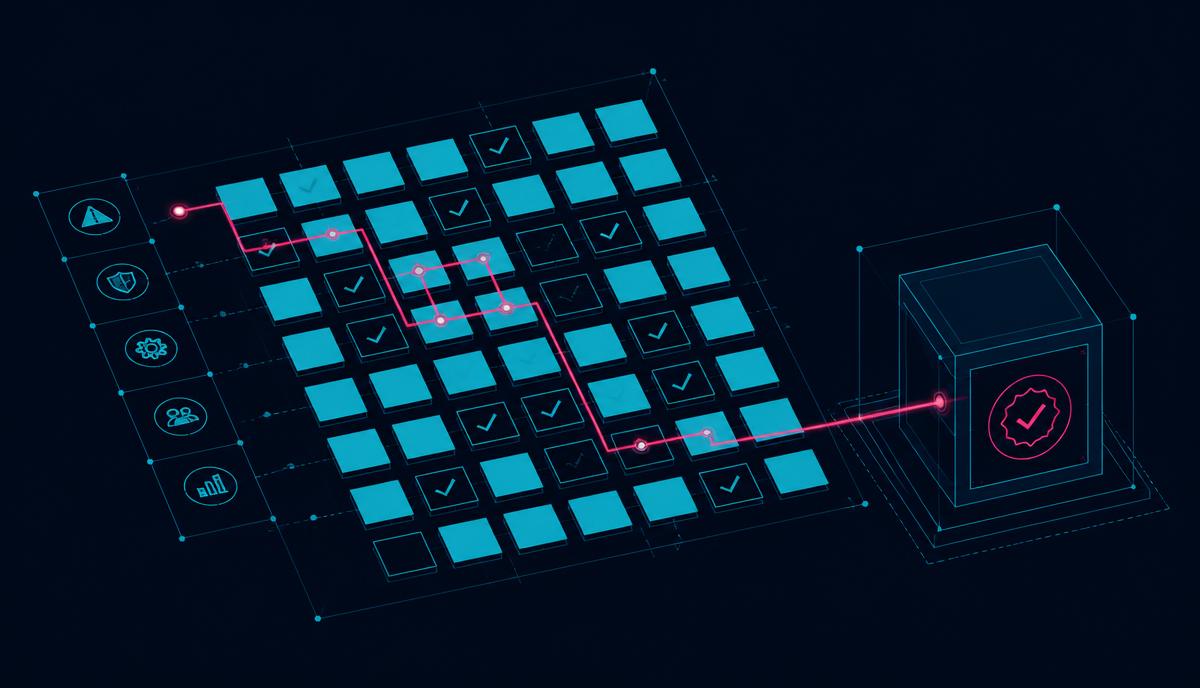
Physical controls are attractive here because their state is observable. A path that is electrically broken is either broken or it is not, and the record of when it was opened is not a configuration setting that can be quietly changed.
Chapter 5Third-party assurance
- Map which suppliers hold live access, not just which hold data.
- Require evidence of access review, not a policy statement.
- Test whether supplier access can be revoked immediately, and by whom.
- Record the regulatory obligations that flow through to each supplier.
Chapter 6The questions to ask
- For each principal control, what evidence would satisfy an external auditor without further explanation?
- Which controls have never been tested independently?
- How many exceptions are overdue, and who accepted them?
- Can we produce an access record for third-party maintenance sessions over the last quarter?
- If a regulator asked how we know our recovery works, what would we hand over?
Chapter 7The evidence checklist
- Risk register entries with owners, treatment decisions and dates.
- Control test results with sample sizes and exceptions.
- Independent assurance reports, internal or external.
- Immutable or offline evidence records for privileged and third-party access.
- Remediation tracking with agreed dates and escalation history.
Chapter 8What happens when preventative controls fail
Prevention buys time. It does not remove the need to answer a simple question: if an attacker holds your identity platform and your management console tonight, what still works tomorrow morning? Most organisations discover that their backup catalogue, their recovery credentials and their runbooks all depend on the systems that have just been taken. That is the dependency worth removing first.
No control removes the possibility of a serious incident. The realistic goal is a smaller blast radius, a recovery path that does not depend on the compromised estate, and evidence that both were tested.
Chapter 9Deciding what you actually need
Compliance frameworks set objectives. They do not, by themselves, deliver resilience, and no product creates regulatory compliance on its own. What a control can do is make the evidence easier to produce and harder to dispute. Firevault is the company. It provides three distinct things, and the honest answer is often that you need one of them rather than all of them.
- Offline Secure Storage® holds a defined set of critical records and clean recovery data physically disconnected from the live estate. It is a protected set, not a replacement for your backup infrastructure.
- Control Modules are a suite of nine purpose-built tools and techniques that give you physical control over the paths into and across your estate. Introduce only the modules that map to the risk you are treating.
- Control Blueprints are proven combinations of those modules assembled for a named outcome, such as containing a live breach or governing third-party access.
If your existing controls already deliver a tested recovery path that survives the compromise of your identity and management planes, and you can evidence it, you may not need any of this. Test that assumption before you buy anything. If you are unsure which of the three applies, the Firevault Concierge walks through the question set without a sales conversation.
Chapter 10The Control Blueprints most relevant to this role
Two blueprints do most of the work in a GRC context. Control by Firevault is a set of nine Control Modules, grouped into the FIRE layer (Firebreak, Isolate, Relay, Execute) and the VAULT layer (Validate, Archive, Unlink, Lock, Transfer). Seven Control Blueprints combine those modules for a specific outcome. You do not need all nine modules, and most organisations start with one blueprint.
- CP-03 Control Third-Party Access uses Validate, Relay, Lock. Read the control third-party access guide.
- CP-06 Prove Compliance Through Control uses Validate, Lock, Archive. Read the prove compliance through control guide.
The full set is on the Control overview and the Control Blueprints index.
CP-06 supports compliance evidence. It does not create compliance. Regulatory outcomes depend on scope, process and governance well beyond any single control.
Chapter 11Where to go next
For the board reporting view, read cyber security for boards. For the regulatory detail, see our NIS2 briefing and ISO/IEC 27001 mapping.
Chapter 12Sources and further reading
- ISO/IEC 27001
- NIST Cybersecurity Framework 2.0
- ICO guidance for organisations
- NIS2 and the UK equivalent regime explained
- NCSC Cyber Security Board Toolkit
Chapter 13About this guide
Author Mark Fermor, Firevault. Reviewed by Firevault compliance review. Last reviewed 28 August 2026.
This guide draws on primary regulatory and technical sources together with Firevault's own field work on physical isolation and offline recovery. It is guidance, not legal advice. Where a legal or regulatory duty is in question, take advice on your own circumstances.
Other guides in this series are listed on the role guide hub.
Where Firevault fits
A recovery copy an attacker cannot reach
Offline Secure Storage® keeps a clean copy of your data on hardware that is physically disconnected, so backup and recovery do not depend on systems an intruder can touch.
- 1Hardware Your copy sits on dedicated encrypted hardware
- 2Disconnect Offline by default, connected only when you say so
- 3Recovery A known-clean copy to rebuild from, on your timetable
- 4Location Held in a secure Firevault Bunker
Related Reading
You may also find these useful

Protecting Students, Peers and Partners: A Practical Education Data Briefing
A practical, forward-looking briefing to help schools, colleges and universities protect students, staff and partner data after the Department for Education breach.

Urgent Briefing and Advice: Protecting Personal Data for High-Profile Figures in the Public Eye
Practical steps for serving and former politicians, councillors, campaigners, journalists, executives, broadcasters and anyone in the public eye, covering email security, device hygiene, threat handling and offline secure storage.

500,000 Volunteers Breached Through Authorised Access: A Controlled Access Buyer's Guide
In April 2026, approved researchers exfiltrated the health records, genetic data, and medical histories of 500,000 UK Biobank volunteers through authorised access channels, then listed the data for sale on Alibaba. The breach was not caused by a hack. It was caused by a model that assumes licence agreements can prevent data theft. This guide covers why that model fails and what physical controls replace it.



Put this guide into practice
Ready to apply what you have learned? Explore how Control by Firevault governs the physical paths into your systems.
From £360 a month including VAT. 36-month commitment. First payment at checkout.

Business
Size your Vault.
2TB, 4TB or 8TB of dedicated hardware, from £360 a month inc VAT.

Larger estates
Request a Storage design.
From 20TB, designed with our solutions team.

Personal
LUV, 300GB.
Identity documents, wills and family archives, opened one day a week.