Firevault Aerospace Playbook

A Control Blueprint for Aerospace & Aviation
Control the Path. Protect the Mission. Preserve the Aircraft.

A 28-page engineering blueprint for communication pathways, operational states, ground and mission segments, MRO and supplier access, rapid isolation and assured recovery across aerospace and aviation.

28 pages
22 min read
Cyber security engineers and OT architects
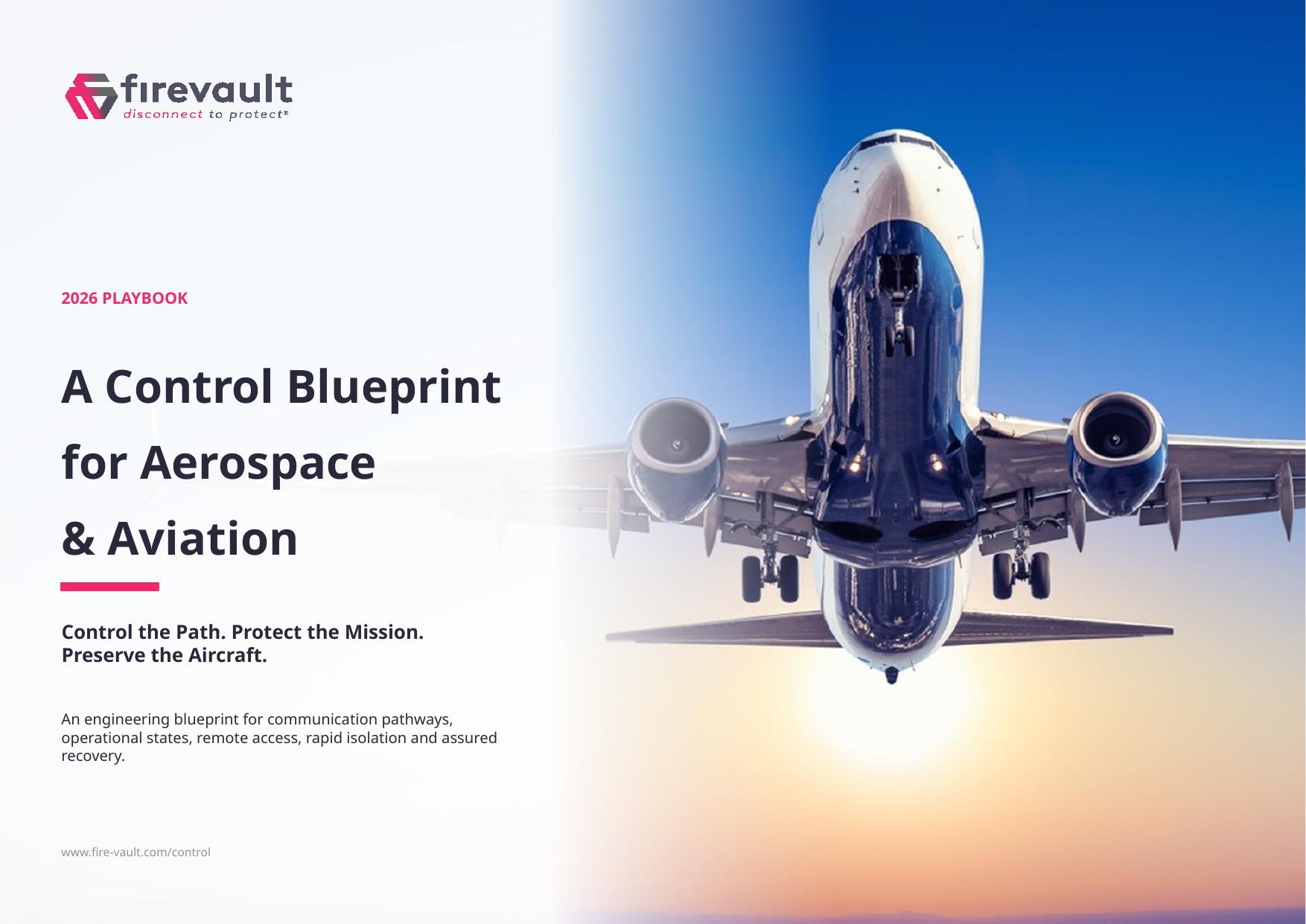
A Control Blueprint for Aerospace & Aviation cover

Get the playbook

Emailed to you within a minute

Personal email addresses such as Gmail or Yahoo are not accepted.

Email-gated GDPR compliant
01Foreword

Written by the people who build the controls.

This is a control blueprint, not an aircraft-security checklist. Aviation control is the discipline of deciding which path may exist, for what purpose, for how long and under whose authority, before connectivity becomes consequence. It sets out the communication registers, operational states and physical controls that let engineering teams govern the pathways an aircraft, an airport and a mission system depend on, so that connectivity is a decision the operator makes, not an assumption inherited from the network. Every Firevault playbook is grounded in the same doctrine behind our Offline Secure Storage® platform: control the path, govern the agent, protect the asset.

Mark Fermor · Co-Founder, Firevault
02What's inside

4 parts. Written for the people who own the decision.

Each chapter opens with the decision it exists to help you make, and closes with the evidence you should expect back.

01

The connected aviation reality

How modern aircraft, airports and mission systems have become continuously reachable, and what that continuous reachability means for engineering control, safety cases and regulatory posture.

  • Connectivity is now a design surface, not a background utility
  • Every open path is a control decision that should be justified
02

Communication airlocks

A pattern language for controlling aircraft, ground and supplier communications: registers of pathways, operational states, and the physical airlocks that decide when a path can exist at all.

  • Pathways move between defined states, not permanent on or off
  • Isolation must be a physical action, not a policy statement
03

Ground, mission and suppliers

How to apply the same control model to airport OT, mission and ground segments, MRO tooling and supplier exchange, so that third-party access is bounded, evidenced and reversible.

  • Third-party access windows are the highest-risk pathway to govern
  • Ground and mission networks need the same registers as the aircraft
04

Rapid protection and adoption

A staged adoption route: baseline register, targeted airlocks, exercised isolation, and a recovery model that proves the fleet, the airport and the mission can be brought back to a known good state.

  • Adoption begins with a register, not a rebuild
  • Rapid isolation and assured recovery are two halves of the same control
03Who it's for

Read it if you're accountable for the decision.

  • Cyber security engineers and OT architects
  • Aviation IT, avionics and mission-system leads
  • MRO, ground operations and supplier assurance teams
  • Airport and airline CISOs and heads of resilience

Sectors we hear from

Commercial aviationAerospace manufacturing and MROAirport and ground operationsDefence and mission systems
05Frequently asked

Questions leaders ask before requesting.

Something else on your mind? Reply to any Firevault email or write to mark@fire-vault.com.

Ready to read it?

Request A Control Blueprint for Aerospace & Aviation. It lands in your inbox within a minute, tied to your email address. No download, no fuss.

    Your privacy matters

    We use cookies to keep the site running smoothly and to understand how you use it. You are in control. Privacy Charter · Cookie Policy