Physical ownership
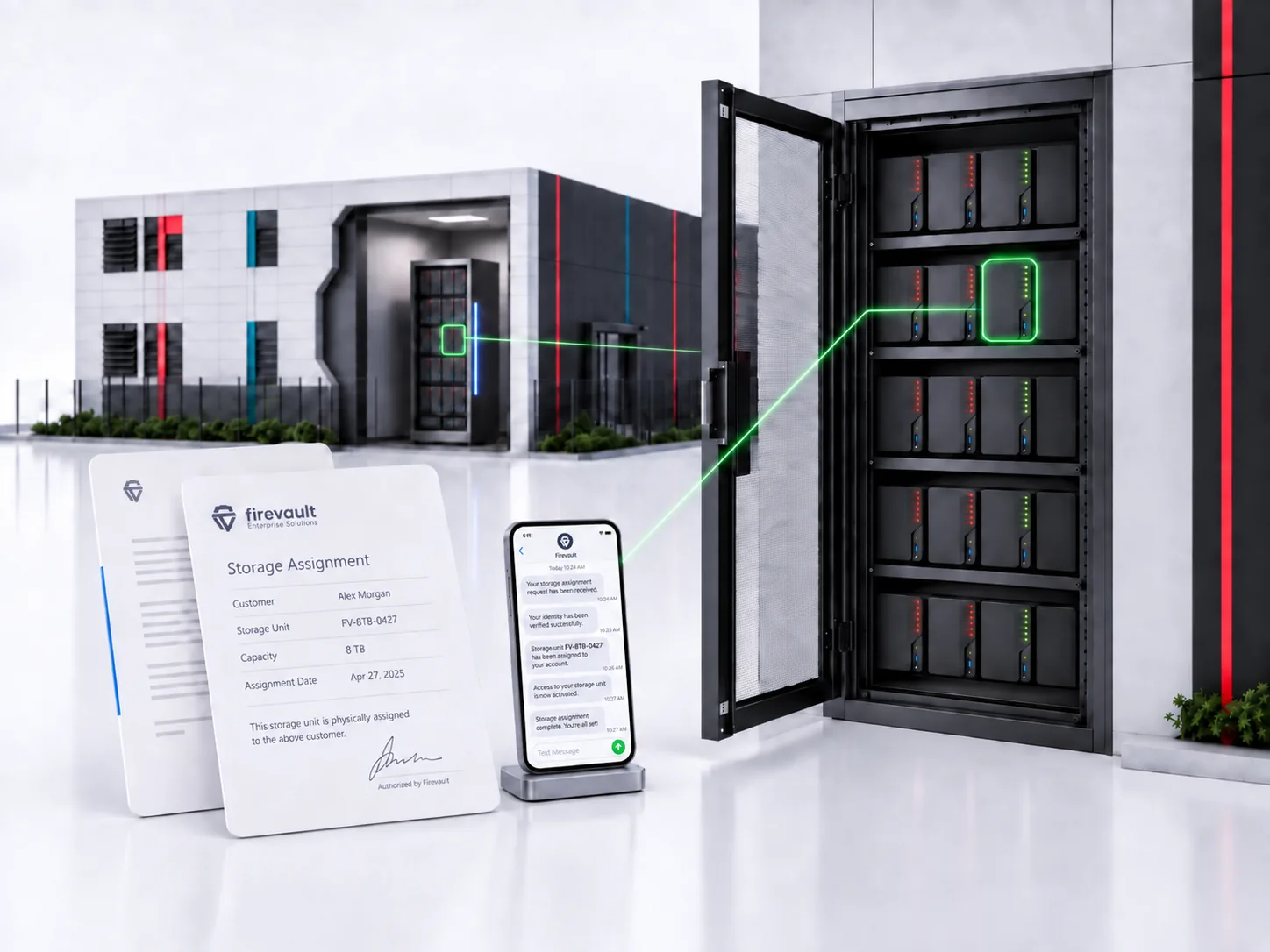
Your Offline Secure Storage instance is assigned to a specific customer with dedicated capacity and a defined lifecycle. Your data is never pooled, commingled or left inside an anonymous shared storage estate.
- Named customer
- Dedicated instance
- Defined lifecycle
- No commingling

- Customer to dedicated instance relationship
- 1:1Customer to dedicated instance relationship
- Other customers on your capacity
- 0Other customers on your capacity
- Hardware lifecycle documented
- 100%Hardware lifecycle documented
- Clear stages from assignment to retirement
- 4Clear stages from assignment to retirement
Ownership should not disappear behind a tenancy dashboard
A cloud account tells you who may use a service. Physical ownership records whose instance it is, what equipment supports it and what happens when the relationship ends.
A named accountable holder
The instance is commissioned against a verified business or individual, not an anonymous storage credential.
Exclusive assignment
The capacity belongs to that instance alone. Other customers cannot occupy or inherit part of it.
A complete lifecycle
Commissioning, maintenance, renewal, return and destruction can all be evidenced against the same record.
How physical ownership is established
Ownership begins with identity and continues through the full hardware lifecycle.
The customer is verified
Business or personal identity checks establish the accountable holder before an instance is commissioned.
A dedicated instance is assigned
Specific capacity and hardware are recorded against that customer rather than added to a shared entitlement.
Custody is maintained
Firevault operates and safeguards the equipment inside a Bunker while the customer's allocation remains distinct.
The ending is explicit
At contract end, the customer renews, retrieves eligible hardware or chooses destruction to certificate.
A storage relationship you can describe precisely
The answer to who, what and when remains clear throughout the life of the instance.
Verified customer
The instance is tied to a known legal entity or verified individual.
Dedicated capacity
Capacity is reserved for one instance rather than shared across unrelated tenants.
Allocation record
The instance and supporting hardware can be identified in Firevault's operational records.
Managed custody
Firevault protects and maintains hosted equipment without converting it into a shared storage pool.
Defined choices at exit
Renewal, eligible return or certified destruction avoids an ambiguous end state.
Enterprise ownership models
Large programmes can purchase equipment in the organisation's name as part of the agreed design.
The other three physical principles
Physical ownership answers whose instance it is. The media, connection state and protected location are separate controls.
Physical storage
The data is held on real, dedicated media rather than in a shared cloud bucket.
Read morePhysical control
Ownership does not mean permanent exposure. The route exists only during an authorised session.
Read morePhysical security
The assigned hardware is held inside a monitored Firevault Bunker.
Read moreHardware return
At the end of the relationship, renew, retrieve the hardware or destroy it to certificate.
Read moreQuestions
Do I own the physical drives in a Vault?
A hosted Vault is allocated exclusively to you and Firevault holds and maintains the equipment. Eligible hardware can be returned at the end of the relationship. Enterprise programmes can purchase equipment in the organisation's name.
Can another customer use my unused capacity?
No. Your allocated capacity is dedicated to your instance and is never pooled or commingled.
Is physical ownership the same as dedicated hardware?
They are closely related but not identical. Dedicated hardware describes single tenancy. Physical ownership adds the verified customer assignment and defined lifecycle.
Who has custody of hosted hardware?
Firevault maintains operational custody inside the Bunker while the instance remains exclusively allocated to the verified customer.
What happens at the end of 36 months?
You can renew, retrieve eligible physical hardware or choose secure destruction to certificate.
Does Firevault gain ownership of my data?
No. Your data remains yours. Firevault provides and operates the physical storage service under the agreed terms.
Move from an account in a storage pool to a defined instance
Choose the Vault capacity your business needs and create an Offline Secure Storage instance assigned to you.