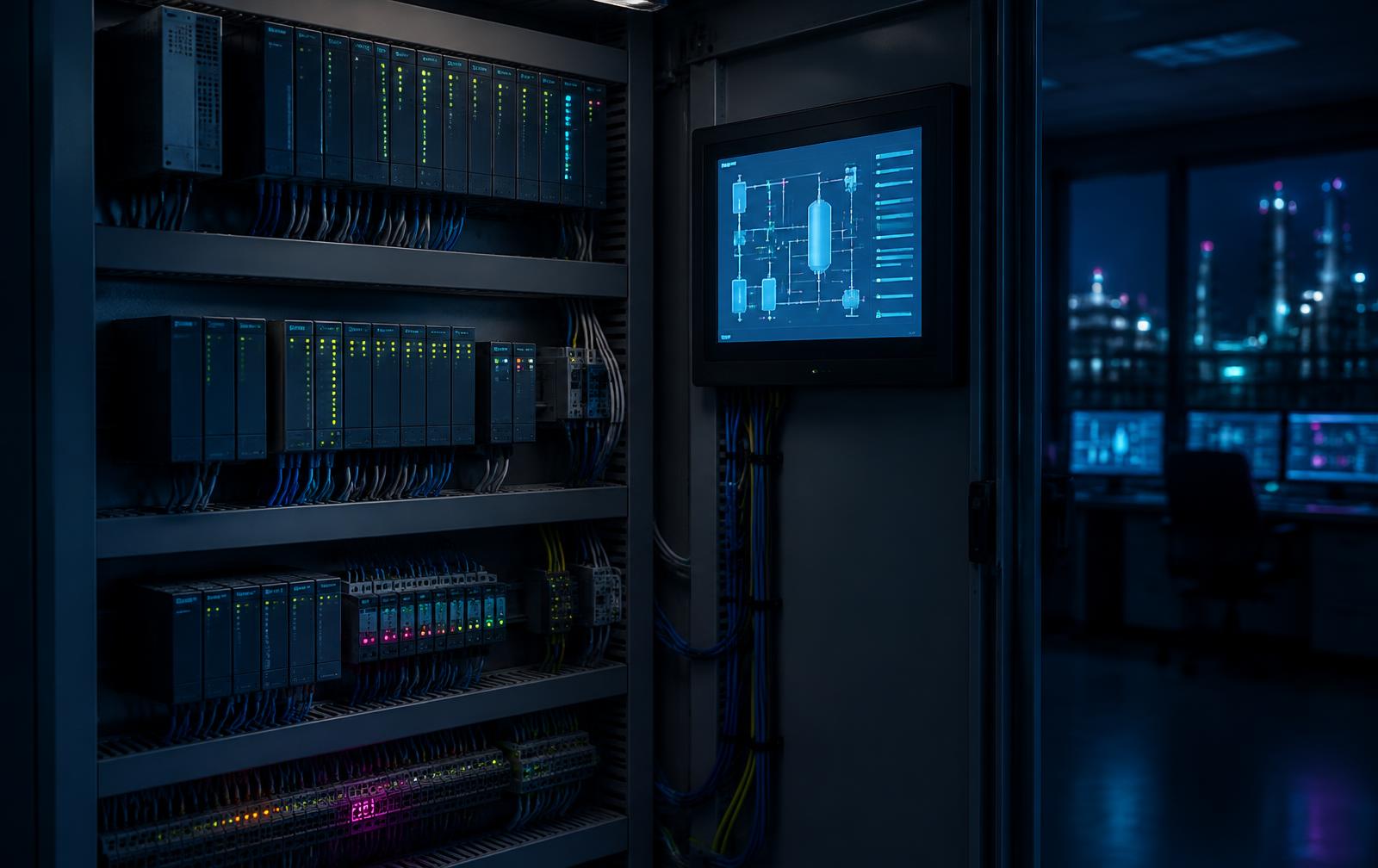

French supermarket chains
- Sector
- Retail & Supermarkets
- What was reported
- A cyber attack was reported to have affected refrigeration equipment at supermarkets in France.
Control by Firevault / ICS Control
Industrial control systems run on PLCs, controllers, HMIs and SCADA that keep processes, cooling and buildings working around the clock. Control by Firevault keeps selected remote routes to them disconnected, opening just-in-time access for approved engineering work.
Which routes can reach your PLCs, and do they need to stay connected?
Incident
Path exposed
Outcome
Control taken
Approximately 120–150 ms
Management enable/disable operation
Around 2–3 seconds
SMS round-trip operation, good signal
March 2025 test observations, not guaranteed timings.
Why connection control matters
A changed set point can spoil stock, stop a line or put equipment outside safe limits. Cutting communications carelessly can also remove the monitoring and alarms operators rely on.
PLCs and controllers are often reachable through vendor modems, cellular routers, building-management gateways or a standing IT/OT link. Many were never designed to defend themselves, and a remote route can change set points, logic or alarms.
Reported incidents in related sectors
These incidents show how a connection path can shape what happens next. They are not claims about what any single control would have prevented.
What Control changes
Control complements your network security, detection, identity management and incident response. It does not replace them. It gives their decisions a physical place to act, on the connections you select.
Control access
Supplier, engineering and partner routes are connected just-in-time for approved work, to named systems, for a set window, and disconnected afterwards. Not open by default.
Control Plans
Control third-party connectionsControl connections in two approved stages
Control exposure
Each critical system keeps the connections it genuinely needs, inside a defined physical boundary. Paths it does not need are disconnected.
Control Plans
Enforce physical network boundariesProtect critical system connections
Control intervention
When your response plan calls for it, the selected path is physically disconnected on a decision by the people or rules you agreed in advance, and stays disconnected until an authorised release.
Control Plans
Contain ransomware spreadContain a live incidentAuthorise emergency disconnection
Where Control applies & Control modules
A refrigeration or automation supplier needs an hour on one PLC. The route opens just-in-time for that booked session, to that controller only, and is physically disconnected again when the work ends.
Where do you need Control?
Relay opens a just-in-time route to the named PLC or controller for approved work, Validate establishes required approval, and Isolate keeps the route disconnected outside that window. Refrigeration, building controllers and process safety remain separately assessed.
Concept illustration. Commanded, reported and independently verified states are shown separately because they are not the same thing, and what can be verified depends on your deployment. Disconnecting a selected path changes what can use that path. On its own, it does not contain an incident across a whole environment, and routes outside the plan, such as wireless or cellular links, need their own controls.
Control Blueprints
How ICS Control applies in the industries where these connections matter most. Each Blueprint maps real systems, suppliers and operating constraints.

Protect the cold chain. Control the connection.
Read the Retail & Supermarkets Blueprint
Treatment and distribution SCADA.
Read the Water Blueprint
Electricity network control systems.
Read the Energy Blueprint
DCS, SCADA and refinery control paths.
Read the Oil & Gas BlueprintFourteen Blueprints are published. Each deployment is designed around your own estate.
Firevault, as featured in





How Control works
Your tools detect, your people and policies decide, and Control changes the connection state of the selected path. Here is what that rests on.
Control changes the connection state of a selected path at Layer 1: connected, or physically disconnected. It does not inspect or alter the traffic on it.
Commands reach each control point over a configured command path, kept separate from the network being controlled. How each point behaves if that path is lost is agreed and tested.
Who can connect, disconnect or release each path is agreed in advance: named people, more than one approval where it matters, or rules and high-confidence alerts you set.
Commands, approvals and reported states can be recorded for your deployment, so you can show what changed, when, and on whose authority.
Before you deploy
Confirm the selected paths, supporting systems and failure behaviour in the actual environment. No generic drawing can substitute for this assessment.
Control governs the selected paths in your plan. It does not inspect traffic, and wireless, cellular and other routes outside the plan need their own controls.
No. They detect, filter and investigate. Control adds a physical way to act on the selected paths when your people, or rules you have agreed, decide to.
No. It changes whether a selected path is connected. It does not read or change what travels on it.
It can, which is why the dependencies, safe states and restoration steps for each path are agreed and tested with your operations and safety owners before anything goes live.
It controls selected connectivity. Disconnecting a path removes the connections an AI system was using and gives people an independent way to intervene. It does not necessarily stop a model or process running locally.
No. Control governs connections. Keeping data physically offline is Offline Secure Storage®, a separate Firevault product that can sit alongside Control.
Yes. Start with one connection: a supplier route, an IT–OT crossing, or the path to one critical system.
Your next step
Begin with one engineering connection. Agree its purpose, intervention authority, dependencies and the checks that make restoration acceptable.
Discuss your Control requirements